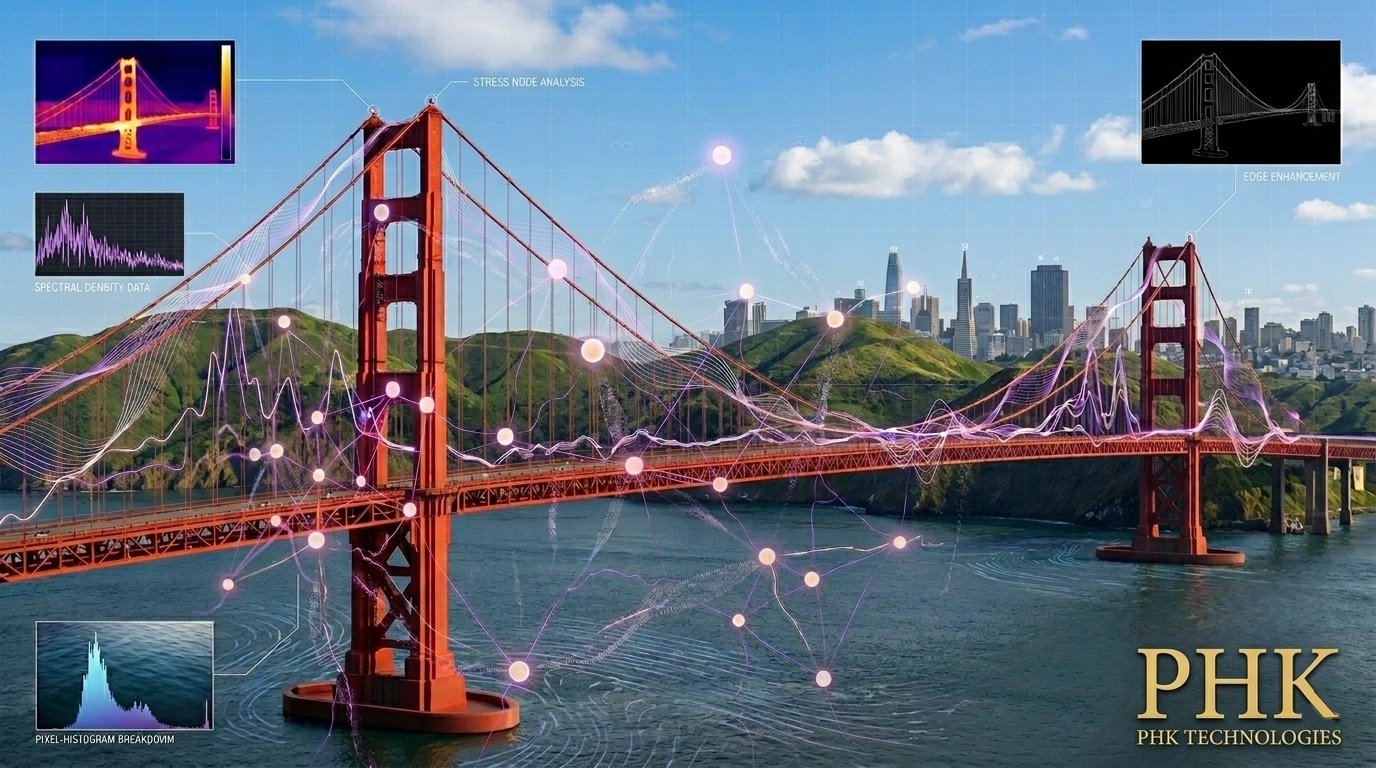
In early 2026, our paper "Signal processing methods for structural health monitoring of bridges: A comprehensive review of classical, data-driven, and hybrid approaches" was published in the Journal of Advances in Bridge Engineering (Springer Nature). Through a four-stage bibliometric process, we identified and analyzed 201 studies focused on bridges, validated across Scopus and Web of Science, spanning from 1985 to 2025.
This post distills the key findings — what 40 years of signal processing research tells us about monitoring bridges, and where the field is headed next.
The Three Camps of Signal Processing
We categorized every study into a clear taxonomy linking sensing methods, signal-processing workflows, and diagnostic models:
1. Classical Methods
FFT, wavelet transforms, and Hilbert-Huang transforms remain the foundation. Acceleration, modal parameters, and frequency components are the most enduring descriptors of structural behaviour. These methods are mathematically rigorous and don't require training data — but they struggle with the non-stationary, nonlinear signals that bridges produce under extreme events.
2. Data-Driven Methods
CNN, LSTM, and wavelet-enhanced hybrid architectures have surged since 2020. These models excel at pattern recognition in noisy environments and can predict nonlinear structural behaviours that classical methods miss. But they remain black boxes — when a deep learning model flags damage, an engineer needs to know why.
3. Hybrid Methods
This is where the field is clearly heading. The most successful recent studies combine classical signal-analysis techniques with deep learning models — using FFT or wavelet transforms to extract physically meaningful features, then feeding those into CNNs or LSTMs. The result: interpretability meets power, with accuracies above 90%.
What 201 Studies Revealed
Four findings from the review that deserve attention:
- Bridges dominate, but gaps remain. Over one-third of SHM studies focus on bridges, buildings, and lab specimens. Complex infrastructure like dams, offshore platforms, and wind turbines are severely understudied.
- Steel and concrete are overrepresented. The overwhelming focus on these materials limits generalizability to composite and emerging material systems increasingly used in modern bridge engineering.
- Vibration-based features still rule. Despite decades of innovation, acceleration and modal parameters remain the most reliable indicators of structural health.
- Graph-based methods are rising. Keyword co-occurrence analysis shows growing interest in fiber-optic sensing, vision-based inspection, hybrid data-fusion schemes, and graph-based learning techniques — aligning closely with my own thesis work.
The Barriers to Real-World Deployment
Despite the impressive accuracy numbers, three obstacles still prevent widespread field-scale implementation:
- Limited real-world datasets. Most ML models are trained on simulated damage data because comprehensive real-world damaged-bridge data is rare. This limits generalization to operational conditions.
- Poor interpretability of ML models. Engineers need to trust the output. Black-box predictions don't support safety-critical decisions.
- No standardized benchmarks. Without common evaluation datasets and metrics, comparing methods across studies remains difficult.
What This Means for Practicing Engineers
If you're responsible for bridge monitoring, here's what our findings suggest:
- Start with classical methods. Vibration-based modal analysis is mature, reliable, and gives you a defensible baseline. You don't need ML to detect a 30% stiffness change.
- Add data-driven methods where you have data. If you've collected years of acceleration records, even a simple autoencoder can spot anomalies classical methods miss.
- Push for hybrid approaches. The best results come from combining physics-based feature extraction with learning models — not from choosing sides.
- Don't wait for perfect conditions. The best SHM system is the one that's deployed. Start collecting data now — the methods, including semi-supervised and transfer learning approaches, will catch up.
Where This Is Headed
The review makes clear that SHM is evolving from a diagnostic tool into a proactive decision-support system. The integration of advanced sensing platforms — fiber-optic and wireless sensor networks — with graph-based learning and multi-source data fusion represents the next frontier. These developments promise scalable, resilient SHM frameworks that strengthen structural safety, sustainability, and life-cycle management across modern bridge infrastructure.
For my own research, this review directly informs the graph theory and computer vision approaches I'm developing for post-earthquake RC column assessment. The same signal processing principles apply — whether you're monitoring a bridge over decades or assessing a column after an earthquake.
If you're working on SHM, signal processing, or damage detection, I'd love to hear from you. Get in touch.