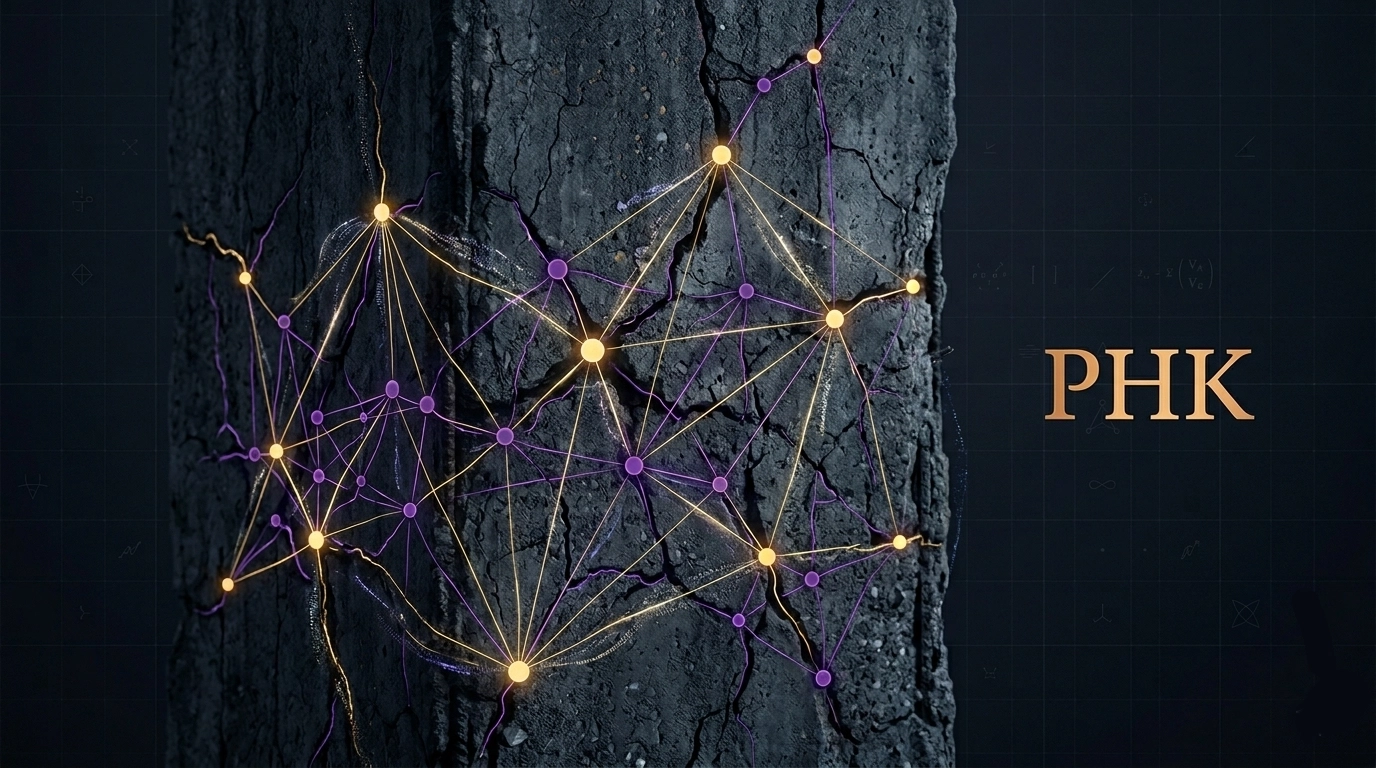
During my MSc at Shahid Beheshti University, I spent months staring at cracked concrete. Not real columns — photographs of them. The question driving my thesis was deceptively simple: can we teach a computer to look at a damaged RC column and quantify how much strength it's lost?
The answer led me deep into graph theory — a branch of mathematics that turns out to be remarkably well-suited for post-earthquake damage assessment. Here's why.
Why Pixel-Based Methods Fall Short
Standard computer vision approaches — CNNs trained on damage images — can tell you if a column is damaged. Some can even segment cracks from the background. But they struggle with the question that structural engineers actually care about: how much lateral strength and stiffness has this column lost?
The problem is that damage isn't just about crack width or length. It's about pattern. A single wide crack near the base is different from a dense network of fine cracks spreading across the surface. Both might cover similar pixel areas, but they imply completely different failure mechanisms.
Enter Graph Theory
A graph, in the mathematical sense, is a set of nodes connected by edges. Apply this to a cracked concrete surface:
- Nodes become crack intersections, crack endpoints, and key geometric points on the column surface.
- Edges become the crack segments connecting them — each weighted by crack width, length, and orientation.
Suddenly, a complex crack pattern becomes a structured dataset. You can compute graph-level features — node degree distribution, clustering coefficients, path lengths, spectral properties — that capture the topology of the damage, not just its visual appearance.
What the Graph Actually Captures
Three structural insights that graph features reveal better than pixel-based methods:
1. Damage Distribution
A column with concentrated damage produces a graph with high-degree nodes clustered in one region. Distributed damage produces a more uniform graph. These signatures correlate strongly with different failure modes — shear vs. flexural.
2. Connectivity Loss
As cracks propagate, the graph's connectivity evolves. Measures like the clustering coefficient and average path length change in predictable ways as damage accumulates. We can track these changes to estimate stiffness degradation.
3. Crack Orientation Patterns
Edge orientation distributions in the graph map directly to principal stress directions. Diagonal cracks, vertical splitting, horizontal flexural cracks — they produce distinct graph signatures that classical computer vision treats as just "damage."
The ML Pipeline I Built
My thesis developed a three-stage pipeline:
- Image Processing: Crack detection and skeletonization using Python and OpenCV, converting raw photographs into crack maps.
- Graph Construction: Converting skeletonized crack patterns into graph representations, with nodes at intersections and endpoints, edges weighted by crack characteristics.
- Machine Learning: Training regression models (and later, graph neural networks) to predict lateral strength and stiffness loss from graph features alone.
The results were promising: graph-based features consistently outperformed pixel-based features for predicting residual structural capacity, especially for columns with complex, multi-directional cracking patterns.
Why This Matters for Practice
After an earthquake, engineers need to make fast decisions: is this building safe to enter? Does this column need replacement or just repair? Current methods rely on visual inspection — which is subjective, time-consuming, and inconsistent.
A graph-based computer vision system, deployed via a phone camera or drone footage, could:
- Quantify damage severity in seconds
- Provide consistent assessments across different inspectors
- Track damage progression over aftershock sequences
- Feed directly into structural models for residual capacity estimation
Where This Is Headed
This thesis work directly connects to the broader structural health monitoring research I'm pursuing. The same graph-based thinking applies whether you're analyzing cracks on a column or sensor networks on a bridge — it's about extracting structured, meaningful features from complex spatial data.
Future directions I'm exploring include graph neural networks that learn directly from graph-structured crack representations, multi-criteria damage assessment combining multiple graph metrics, and integration with digital twin frameworks for lifecycle monitoring.
If you're working on computer vision for structural assessment, graph-based methods, or SHM, I'd love to connect. Get in touch.