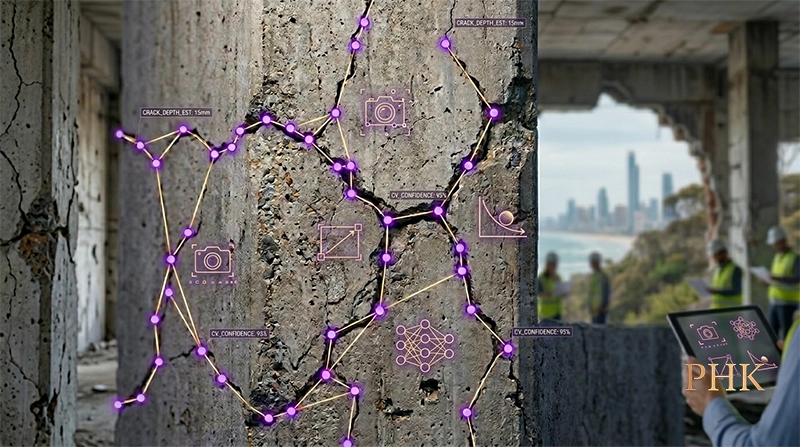
Every earthquake leaves behind a dataset. It's written in cracked concrete, spalled cover, and exposed rebar. For decades, we've read that data with our eyes — sending inspectors to log damage manually, column by column. Pouya H. Khosravi (also published as Pouya Khosravi Hajivand), an earthquake engineer specializing in seismic assessment, believes we can do better.
The answer lies at the intersection of computer vision and machine learning — training algorithms not just to see cracks, but to understand what they mean for structural safety.
Beyond Pixel Counting
Standard image-based methods answer the wrong question. They tell you where cracks are and how wide they've opened. But an earthquake engineer needs to know something deeper: how much strength and stiffness has this column lost?
A single diagonal crack near the base means something completely different from a web of fine flexural cracks across the surface — even if they cover similar areas. Pixel counting misses the structural story. Pattern recognition captures it.
Why This Matters Now
After a major earthquake, inspection teams face thousands of buildings and days to decide which are safe. The current process — visual inspection by individual engineers — is slow, subjective, and inconsistent across inspectors.
Computer vision and machine learning, deployed through phone cameras or drone footage, could compress that timeline dramatically. The same algorithms that identify a cat in a photo can be trained to identify a shear-critical column — and go further, to estimate the damage severity in engineering terms.
Connecting the Dots
This work on post-earthquake seismic assessment connects directly to my broader research in structural health monitoring and the signal processing review published earlier this year in the Journal of Advances in Bridge Engineering. Whether analyzing a single column or a sensor network on a long-span bridge, the principle is the same: extract structure from data, and data becomes a decision.
If you work in structural assessment, infrastructure monitoring, or applied machine learning for civil engineering, I'd welcome the conversation. Get in touch.