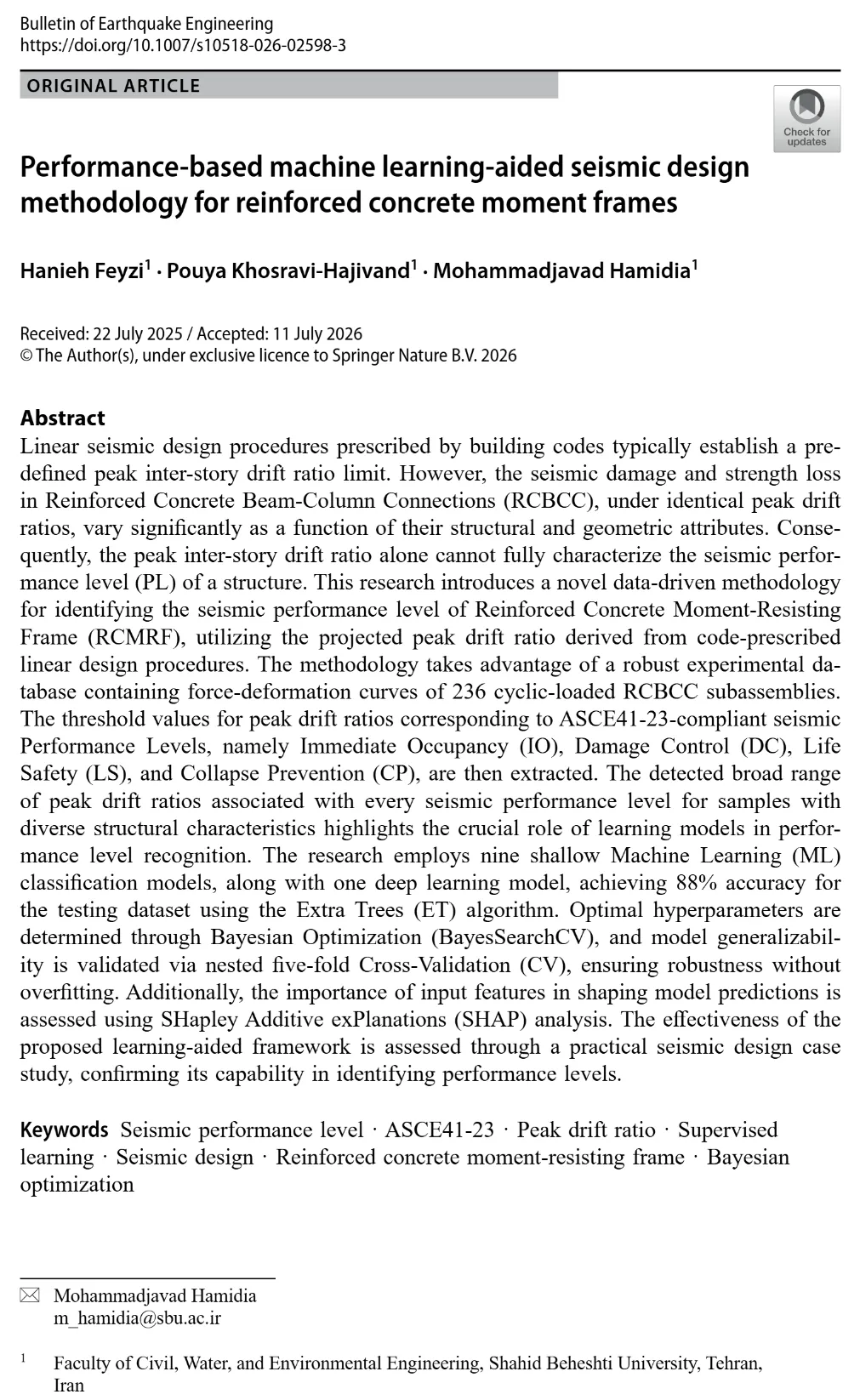
Two reinforced concrete frames can have the same peak inter-story drift ratio — and still experience very different levels of damage.
That single observation is what drew me into this study. Peak inter-story drift is one of the most familiar quantities we use in seismic design. But when you look closely at reinforced concrete beam-column joints, the relationship between drift and damage becomes less straightforward.
The same drift ratio does not necessarily mean the same seismic performance.
That question became the foundation of a paper I'm glad to share:
Journal: Bulletin of Earthquake Engineering
DOI: 10.1007/s10518-026-02598-3
The Problem with Drift Limits
Linear seismic design procedures prescribed by building codes typically establish a predefined peak inter-story drift ratio limit. The engineer computes the drift, compares it to the limit, and — if it passes — assumes the structure meets its intended performance objective.
But the seismic damage and strength loss in reinforced concrete beam-column connections (RCBCC) under identical peak drift ratios vary significantly as a function of their structural and geometric attributes. The drift ratio alone cannot fully characterize the seismic performance level of a structure.
Two columns with the same drift may differ in:
- Reinforcement ratio and detailing
- Axial load level
- Shear span-to-depth ratio
- Confinement quality
- Failure mode (flexural, shear, or mixed)
A single drift threshold treats all of these as equivalent. They are not.
The Question I Set Out to Answer
If drift alone can't reliably indicate performance level, can we use the information already available from conventional design — and let machine learning recognize the actual performance level?
This is not about replacing engineering judgment. It's about giving engineers better eyes to see what the conventional numbers sometimes hide.
The Approach: Learning from 236 Cyclic Tests
I worked with an experimental database of 236 cyclically tested reinforced concrete beam-column subassemblies. Each specimen has a force-deformation curve and known structural and geometric attributes.
From this dataset, I extracted the threshold values of peak drift ratio corresponding to the seismic Performance Levels (PLs) defined by ASCE 41-23:
- IO — Immediate Occupancy
- DC — Damage Control
- LS — Life Safety
- CP — Collapse Prevention
The result was striking. For a given performance level — say Life Safety — the range of peak drift ratios across specimens with different structural characteristics was broad. Overlapping ranges across adjacent performance levels confirmed that drift alone cannot distinguish them.
This is precisely where a learning model can help.
Nine ML Models, One Deep Learning Model
I compared nine shallow machine learning classification models along with one deep learning model to see how effectively they could distinguish seismic performance levels from the input features.
The best performer was the Extra Trees (ET) classifier, achieving 88% accuracy on the testing dataset.
But accuracy alone wasn't enough. I took three additional steps to ensure the model was trustworthy, not just well-fit:
- Bayesian Optimization (BayesSearchCV) — for hyperparameter tuning, more efficient than grid or random search
- Nested five-fold cross-validation — to evaluate generalizability and reduce the risk of overfitting, particularly important given the modest dataset size
- SHAP analysis (SHapley Additive exPlanations) — to understand which features were actually driving the predictions
The SHAP analysis is one of the parts I find most valuable. It doesn't just tell you the model works — it tells you why. Which structural features matter most for distinguishing Immediate Occupancy from Life Safety? Which features are essentially noise? For an engineer, that interpretability matters as much as accuracy.
Practical Validation
Finally, I tested the framework through a practical seismic design case study. The goal was to confirm the methodology could be applied to an actual design scenario — not just to the training dataset.
The framework successfully identified the seismic performance levels of the case-study structure, demonstrating its potential as a practical design aid.
What This Means for Practice
This paper sits at the intersection of two directions I find increasingly important:
Performance-based design — where we stop treating a single drift limit as sufficient and start asking what performance level a structure is actually expected to reach.
Data-driven methods in earthquake engineering — where we use the vast quantity of experimental data collected over decades to inform better decisions.
This is not a replacement for experimental testing or nonlinear analysis. It's a complement — a way to use data that already exists to improve the accuracy of design decisions.
The broader point: as our experimental databases grow, our ability to learn from them grows with them. Papers like this are one step in that direction.
Paper Access
The full paper is available in Bulletin of Earthquake Engineering:
https://doi.org/10.1007/s10518-026-02598-3
If you don't have journal access and would like a copy for research purposes, feel free to reach out.
Related Concepts in the Seismic Lexicon
If you want to dig deeper into the concepts referenced here, these entries from the PHK Seismic Lexicon are directly relevant:
- Story Drift — the parameter this paper questions
- Performance-Based Design — the framework the paper operates within
- Ductility — a key property of the RC connections studied
- Machine Learning — the methodology used
- Monte Carlo Simulation — related probabilistic methods
Citation
If you use or reference this work, please cite:
Discussion
0 commentsPlease log in to join the discussion.
No comments yet
Be the first to share your thoughts!