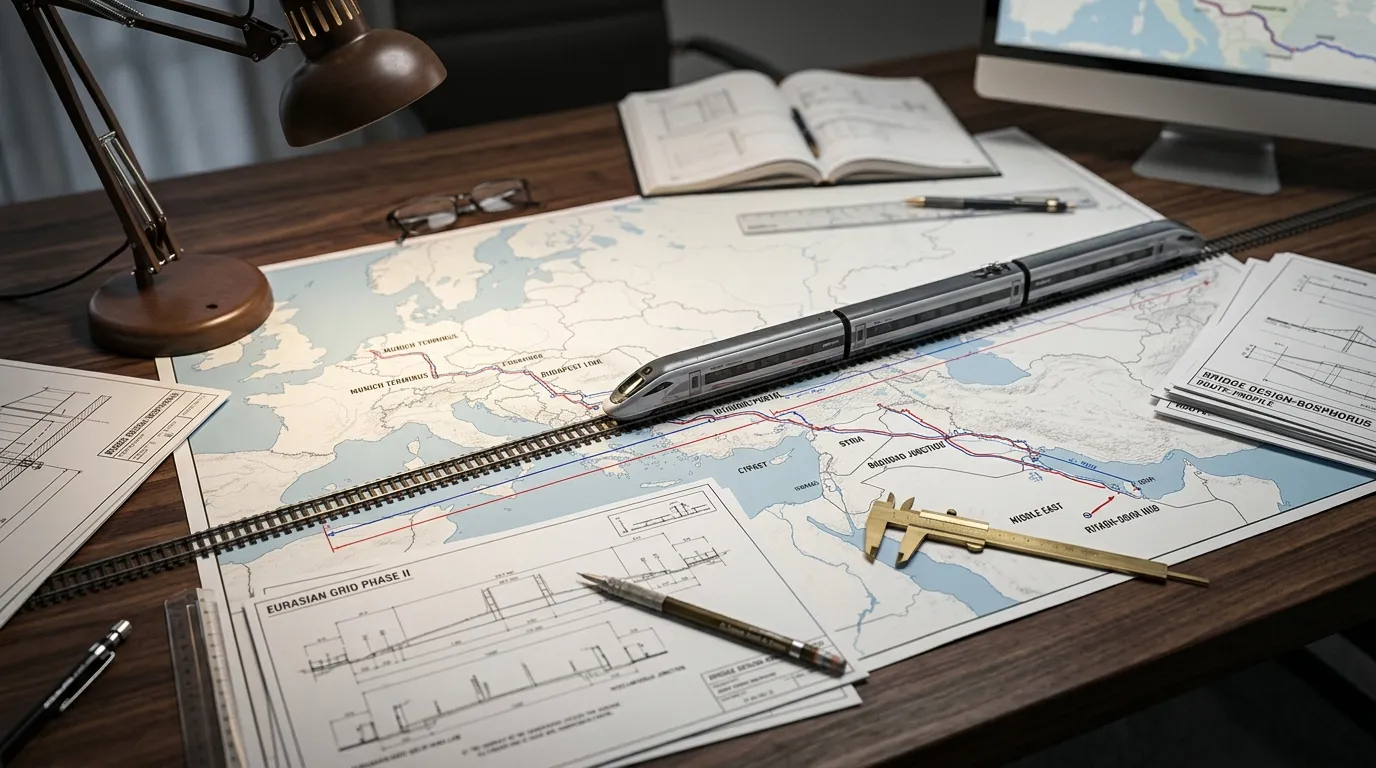
On 9 June 2026, Saudi Arabia and Turkey signed two memorandums of understanding in Riyadh — one on railway cooperation, one on logistics services. The stated ambition: a rail corridor linking Saudi Arabia to Turkey through Jordan and Syria, and potentially onward to Europe.
The agreements were signed by Saudi Minister of Transport and Logistic Services Saleh Al-Jasser and Turkish Minister of Transport and Infrastructure Abdulkadir Uraloglu. A joint feasibility study is already underway, with Al-Jasser stating it should conclude by the end of 2026.
What follows is an engineering read of the corridor: what already exists, what doesn't, what the technical obstacles genuinely are, and — importantly — which questions the MOUs do not answer.
What the MOUs Do — and Don't Do
This distinction is worth stating plainly, because reporting on the agreements has often blurred it.
A memorandum of understanding commits the parties to cooperate. It does not commit funding. It does not fix a route. It does not allocate risk. It does not establish a delivery entity or a construction timeline.
The two MOUs cover:
- Railway cooperation — infrastructure, technology, standards, safety, engineering, training, and operations.
- Logistics services — including logistics centres and multi-modal interfaces.
What they mean in practice: both governments agree the concept is worth studying. That's it. The feasibility study now underway is the meaningful next step. A defined alignment, binding agreements, and identified financing lie beyond it — and none of those is guaranteed to follow.
This is not a criticism. It's how large cross-border infrastructure projects begin. But it's also why reading "Saudi Arabia is building a railway to Europe" from these headlines would be premature.
What Already Exists — and What Doesn't
The starting position is stronger than it first appears.
On the Saudi side, rail infrastructure already extends from Riyadh toward Al-Haditha near the Jordanian border. The North Train passenger route runs approximately 1,250 km in that direction, and the transport minister has confirmed the national network reaches the Jordanian border.
On the Turkish side, work has begun. Turkey has restored rail lines near the Syrian border out of service for roughly 15 years, and committed USD 100 million to rehabilitate the Turkey–Aleppo link.
The missing section is the middle: through Jordan and Syria to Turkey. Reuters has reported approximately 400 km of missing track between Syria and Jordan as the core infrastructure gap. Iraq has been mentioned as a possible additional participant, but is not part of the currently studied route.
Syria's Transport Minister Yarub Badr gave one concrete data point: the Damascus-to-Jordanian-border section alone is estimated at approximately USD 250 million. That's one segment, not a budget.
Track Gauge: The Constraint Nobody Talks About
When a project like this is announced, public attention lands on politics and money. Ask a railway engineer what actually worries them, and you'll often get a one-word answer: gauge. Not because it's technically exotic — it isn't — but because it's a decision that has to be made early, costs a fortune to reverse, and quietly constrains everything downstream.
The bare facts: Saudi Arabia, Turkey, and most of Syria's modern network run on 1,435 mm standard gauge. Jordan's surviving Hejaz-era track is 1,050 mm narrow gauge. Those two numbers are not compatible. A standard-gauge freight consist out of Riyadh cannot physically traverse a narrow-gauge line into Amman. The wheels don't sit on the rails. No amount of signalling sophistication or control-system integration bridges that gap — it's a physical constraint at the level of steel on steel.
Textbooks will tell you gauge conversion is "established practice." Technically true. It's also the kind of phrase that hides the actual scope. Rebuilding a railway to a different gauge is closer to building a new railway than rehabilitating an old one. Three paths exist, and only one is realistic:
- Full reconstruction to standard gauge. Every meter of track gets replaced. Bridges whose pier spacing was optimized for narrower loading get re-analyzed — and often rebuilt. Tunnels sized for small rolling stock become clearance problems. Curves that met Ottoman-era geometry standards get re-aligned for modern speeds, which changes earthwork volumes along the entire route. This is the only option that produces a corridor the commercial case actually depends on, which is why it's the one that tends to get selected despite the cost.
- Dual-gauge track. Lay a third rail so both gauges share the alignment. Elegant in theory; painful in execution. Every switch, every diamond crossing, every bridge interface becomes a non-standard design. Dual-gauge works on short shared segments in industrial yards. Over 400 km of mainline freight corridor, the complexity and maintenance burden usually overwhelm whatever was saved on construction.
- Transshipment at the gauge break. Crane the container off one train and onto another. This is how some international corridors handle gauge mismatches today, and it functions. But it directly contradicts the entire premise of a through-corridor — the reason you build a land bridge is speed. Stopping to reload cargo erases that advantage and hands the traffic back to ships.
Realistically, the Jordanian segment is not a gauge conversion. It's a re-build. What survives of the historic Hejaz alignment is the right-of-way — the surveyed corridor, the earthworks footprint, and the general sense of where a railway between these cities should run. That has value; the Ottoman engineers who picked the route weren't amateurs. But the right-of-way is not track, and it isn't structures, and it isn't a design. Estimating this segment as "rehabilitation" would understate the actual scope by a wide margin.
There's a subtler point that rarely surfaces in early announcements: the alignment carries a design speed, and design speed is destiny. Minimum curve radii, cant, transition lengths, and clearances all flow from that single number. If the reconstructed corridor inherits the historic alignment's curvature, the achievable line speed stays modest — which weakens the commercial case against sea freight because the transit-time advantage shrinks. If the alignment is re-engineered for modern speeds, the earthworks expand, the bridge count rises, and the "existing corridor" becomes a much more expensive greenfield proposition. Whichever way it goes, this is a decision that will be made quietly in a feasibility study and then bind the project for fifty years. It deserves more attention than it typically gets.
Syria: Reconstruction Is the Easy Word for It
Syria's rail network stopped functioning in 2012. Fragments resumed service in 2020, but between those dates the infrastructure was not merely idle — it was contested, shelled, cut, and in some places stripped for scrap metal. A rail line that operated continuously for a century doesn't come back to life simply because the fighting has paused.
Calling the Syrian segment a "reconstruction" project is technically accurate. It still understates what any engineer opening a design file would actually face. The distinction matters because the two project types start from different places. A rehabilitation project begins with a known asset — you have drawings, as-builts, condition records, and you're restoring it. A reconstruction project begins with an unknown one. You have to establish what you're building on before you can decide what to build. Syria, right now, is firmly in the second category.
Before preliminary design could meaningfully begin, four bodies of work would need to be completed — and, per published reporting, none of them is yet in place:
- Bridge condition assessments. Not "are the bridges standing?" but "are the foundations intact, has the deck been overloaded by a decade of informal heavy traffic, is the pier sitting on stable ground?" You cannot answer any of those questions from satellite imagery. Each bridge needs to be physically inspected, cored where necessary, and re-analyzed against modern design loads — which are almost certainly higher than what the original structures were designed for.
- Tunnel lining surveys. Tunnels are the hardest railway asset to assess from a distance. A hairline crack in a photograph can be superficial or structurally critical; you don't know until you core it. Every tunnel on the alignment needs a lining assessment, and the outcomes will split three ways: re-line, widen for modern clearance, or bypass entirely. Each option carries a very different cost, and the split won't be known until the surveys are done.
- Geotechnical baseline. Damaged earthworks don't behave like intact ones. An embankment that sat quietly for fifty years can turn unstable after a single winter of altered drainage. The alignment crosses terrain that has been subject to military traffic, unplanned earthworks, and vegetation changes. A proper geotechnical baseline — borehole data, groundwater mapping, slope stability analysis — is a multi-year undertaking that has to run parallel to, not after, the alignment studies.
- Right-of-way verification. After fourteen years of conflict, "the railway corridor" may no longer exist on the ground as a legally or physically continuous strip of land. Informal construction, encroachment, and unrecorded damage complicate every kilometer. Re-establishing the legal corridor is a task in itself, separate from any physical engineering.
What this means for the budget: you cannot cost this segment from a drawing. The published figure of roughly USD 250 million for the Damascus-to-Jordanian-border section is a placeholder, not an estimate. It signals order of magnitude — "hundreds of millions, not billions, for this piece" — but the real number depends entirely on survey findings that don't exist yet. When they do, expect the figure to move by factors, not percentages. That's not pessimism; it's how unknown-condition brownfield projects always resolve.
The honest engineering read: Syria isn't the hard part because the technical work is exotic. Standard railway reconstruction is well understood. Syria is the hard part because you don't yet know what you're building on. The project can't move into serious design until it does — and getting to that point is the long pole, not the construction itself.
The Passenger and Pilgrimage Dimension
Freight carries the commercial case, but the corridor has a second dimension worth noting.
Turkish officials have said the future connection could facilitate pilgrim travel — and the historic Hejaz Railway itself was originally built partly to carry pilgrims toward Medina. A modern corridor integrated with Saudi Arabia's wider passenger network, including the Haramain High Speed Railway serving Makkah and Madinah, could revive that function at contemporary speed.
Important caveat: the June agreements do not establish a route through either Makkah or Madinah. The pilgrimage dimension is aspirational and would require integration decisions beyond the current study.
The Strategic Case: What Freight Can Realistically Shift
Cross-border rail corridors get oversold. Enthusiasts treat them as replacements for sea freight; skeptics dismiss them as white elephants. Both miss the point.
Sea freight from the Gulf to Europe moves through the Suez Canal. That's a chokepoint, and it has been demonstrated repeatedly in recent years — the 2021 grounding, the 2024 Red Sea disruption, and ongoing security dynamics — that a chokepoint is a strategic liability. Rail cannot replace Suez. The volume mismatch is an order of magnitude. But a functioning land corridor changes the calculus on two specific segments of trade:
- Time-sensitive, higher-value cargo — where an eight-to-ten-day sea transit is a commercial cost and a five-to-seven-day rail transit is a commercial win. Automotive components, pharmaceuticals, electronics, and specialized industrial inputs fit this profile.
- Contingency capacity — during a maritime disruption, having an alternative route for some cargo is worth more than the corridor's routine economics would suggest. Resilience has a premium that doesn't show up in cost-per-container analyses.
What rail will not do: move bulk commodities. Grain, ore, and raw petrochemicals will keep going by sea because the unit economics don't work otherwise. The corridor's addressable market is narrower than "Gulf-to-Europe trade" and specific enough to plan around.
There's a second commercial question that rarely appears in the political framing: who operates the corridor? Sea freight has mature, competitive operators, established insurance markets, and predictable customs regimes. A new land corridor needs to build all of these from scratch. The freight forwarders who decide where a container routes will choose the corridor only if it's simpler and more predictable than the alternative — not just faster on paper. Getting there requires commercial integration to match the engineering integration, and that is often the slower of the two.
From a preliminary-design standpoint, the sequencing matters more than the timeline. The natural order is: (1) surveys, (2) alignment decision, (3) gauge and standards agreement, (4) financing, (5) construction. Each stage constrains the next. Attempting stage 3 before stage 1 is complete — agreeing on standards for an alignment you haven't surveyed — is possible, and common in cross-border projects, but it produces expensive re-work later when reality diverges from the assumption. The most useful thing a feasibility study can do is force the sequence, not just produce a schedule.
What Would Signal Real Progress
Five indicators will distinguish genuine advance from diplomatic activity. None is yet in place — which is entirely normal at this stage:
- Completion of the feasibility study — expected before the end of 2026.
- Publication of a defined alignment — especially where the route crosses Jordan and Syria, and whether existing corridors are rebuilt or bypassed.
- A standard-gauge solution through Jordan and a rehabilitation plan for Syria's network.
- Binding multilateral agreements covering customs, operations, signalling, maintenance, and border procedures.
- A financing structure — particularly for the reconstruction and new-build sections in Syria and Jordan.
Until several of these appear, the correct description of the corridor remains what it is: a serious, jointly studied ambition, at the beginning of a long road.
What This Means for Engineers
For civil and railway engineers, this is a project worth tracking — not because construction is imminent, but because the technical scope is unusually broad and the constraints unusually well-defined.
The specific domains this corridor will require:
- Permanent way design — alignment, ballast, sleepers, and rail section selection for mixed freight and passenger loading.
- Structures — bridge replacement and repair, tunnel assessment and re-lining, earthworks stabilization.
- Signalling and telecoms — interoperable systems across four operating authorities.
- Geotechnical engineering — foundation assessment for structures of unknown or degraded condition.
- Logistics and terminal design — border facilities, marshalling yards, and intermodal interfaces.
The engineering challenges are substantial but largely within established railway practice. The more difficult constraint is institutional: maintaining agreement across multiple countries on standards, financing, border operations, signalling, safety, and long-term infrastructure management — held together across borders and over the decades such a corridor takes to build.
That is the real megaproject. The railway itself is achievable.
Sources & credit: This analysis is based on reporting and technical coverage by CEW Magazine — "Gulf to Europe by Rail? Saudi–Turkey Agreements Revive a Historic Corridor", with additional context from Saudi Ministry of Transport and Logistic Services, Turkish Ministry of Transport and Infrastructure, Saudi Arabia Railways (SAR), Reuters, and the Saudi Press Agency. Status as reported to September 2026 — a jointly studied proposal, not an approved construction programme.
Discussion
0 commentsPlease log in to join the discussion.
No comments yet
Be the first to share your thoughts!